


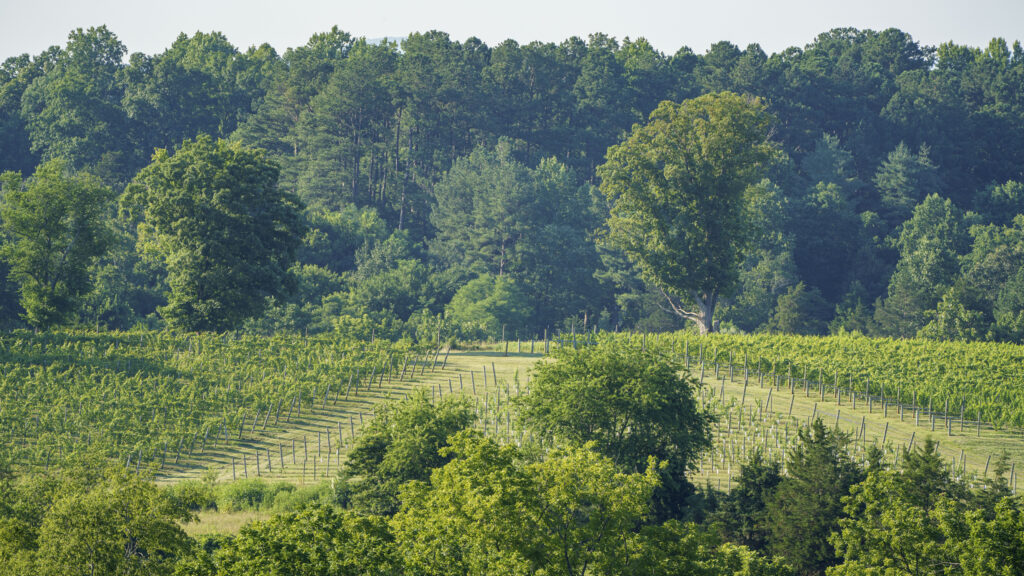
This Earth Month, we asked Logan Collins, our Farm & Vineyard Manager, to share his philosophy guiding the work on the farm.
What follows is his perspective, an honest look at how we are thinking about soil, farming, and the long road back to balance.
Guiding Philosophy on Farming
At it’s core, our approach to farming is centered on the idea that soil biology (bacteria, fungi, nematodes, protozoa, earthworms, etc) are the essential bridge between minerals and plants. Plants use the sun (photosynthesis) to synthesize compounds for its own use and to feed soil biology thru root exudates.
Soil biology uses these sugars excreted by plant roots as an energy source. That food source enables them to go out into the soil ecosystem to obtain minerals that they need to synthesize their own compounds that are used to grow their own bodies and also feed back to the plant. These compounds are much more efficient and healthy for the plant to use as nutrient sources than conventional fertilizers.
Unfortunately, most of our modern farming practices destroy soil biology and the interaction above are critically interrupted to the point where we need constant intervention with pesticides and fertilizers because the soil biology does not exist in enough abundance and diversity to supply the plants with what they need to fight off pests and grow.
Abundant and diverse soil biology leads to healthy soil.
Healthy soil leads to healthy plants that fully express their genetic potential i.e. fruit characteristics and plant defense systems.
So, what are we doing to rebuild this plant/biology bridge in the vineyard:
- Addressing soil fertility through building biology and applying compost and fertilizer that is friendly to biology.
- Since most of our plants (both vines and vineyard understory) are not functioning at a high level and secreting many sugars; we’re trying to prime the system by spraying food for biology on the ground before rains. We’re currently focusing on vermicast (worm poop) extracts, humates, fish hydrolysate, molasses and kelp as they contain compounds biology can eat.
- It’s difficult to grow something from nothing so in 2026 we are going to use fertilizer that is more biologically friendly. The goal is to help the plants grow more, produce more sugars and feed/grow our biology numbers while also not harming them to the same degree as traditional synthetic fertilizers. We also make and apply heaps of compost throughout the year. The compost is not intended to provide nutrients but rather be a source of food for biology.
- Plants and biology are critically dependent on oxygen in the soil and our soils are severely deficient due to compaction. We’re currently using a Yeomans plow that effectively lifts the soil up with minimal disruption to surrounding plants. Their roots will then go deeper since there is now space and biology can also go deeper since there is now oxygen.
- Although this “nature knows best” philosophy is our long-term plan, we still need to harvest grapes. Plant degrading pathogens will always be present to some degree so we must understand when action is needed and what materials will work best within our context. Although we do not use herbicide or synthetic insecticides, we are working to balance our use of synthetic fungicides and bio-fungicides. Currently, our hope is to use 80% bio-fungicides and 20% conventional. Within that conventional umbrella we do not use Manzate or Captan.
- Bio-funigicides are composed of micro-organisms that have been found to fight parthenogenic biology through various mechanisms.
As we celebrate Earth Month, we continue to recognize that this work is never about getting it perfect the first time. It is about paying attention. Adjusting. Returning to the land with a deeper understanding than before.
Each season teaches something new, and with that comes a responsibility to respond with intention. To care for the soil, to support the life within it, and to make decisions that move us closer to balance, even when the path is not linear. This is a long game. One rooted in respect, in curiosity, and in a deep commitment to the land we are fortunate to steward.